Venice Travel Quick Guide
Where to stay:
Hotel Londra Palace — a historic waterfront boutique hotel steps from St. Mark’s Square — is quieter than most nearby properties, offering a sense of Venice’s true luxury and access to the city’s quieter streets.
Best neighborhood for atmosphere:
Castello sestiere, Venice’s largest district and one of the few areas near St. Mark’s Square that still feels authentically Venetian.
Best time to visit:
Late April–June and September–October, when Venice’s weather is mild, and crowds are lighter.
Key Insights
- Venice's historic Hotel Londra Palace offers an authentic and quieter luxury experience near St. Mark's Square.
- Late spring and early fall are the best times to visit Venice for mild weather and fewer crowds.
- Hotel Londra Palace, with its rich history dating back to 1853, has hosted famous guests like Tchaikovsky.
Don’t miss:
An evening walk along the Riva degli Schiavoni promenade toward the Venetian Arsenal, where the lagoon views open wide and the crowds thin dramatically.
Venice — experienced properly — is far more than canals and souvenir shops. It is a privilege for travelers who embrace wandering without a strict plan and let the city reveal itself slowly.
Venice feels suspended in time. At any moment, it seems as though a masked procession might sweep through a nearby piazza and pull you into a centuries-old celebration.
Staying at Hotel Londra Palace in Venice’s Castello district places you directly inside that atmosphere, where the city feels both historic and alive.
Just steps from St. Mark’s Square, the crowd thins out, you can walk without dodging sun-shading umbrellas, and there is the Londra Palace, offering one of the most authentic ways to experience Venice.
The history behind Londra Palace
Venice was once known as La Serenissima, the Most Serene Republic. But serenity can be difficult to find during peak travel months when visitors flood the city’s narrow bridges and lanes.
Walk east along the Riva degli Schiavoni promenade, and the rhythm changes.
The lagoon opens wide toward the Adriatic Sea. Gondolas drift quietly through the basin. Locals stroll along the waterfront in the evening light.
The Londra Palace, built in 1853, has stood on this waterfront for more than 170 years.
Over time, it welcomed writers, composers, and artists drawn to Venice’s atmosphere. One of the most famous guests was Pyotr Ilyich Tchaikovsky, who stayed here in December 1877 and composed the first three movements of his Symphony No. 4 during his visit.
Today, the boutique luxury hotel offers roughly fifty rooms and suites overlooking either the San Marco Basin or the rooftops and bell towers of the Castello sestiere.
Inside the suites
A junior suite overlooking the San Marco Basin immediately creates a sense of quiet.
Fabric-covered walls soften both sound and light. Plush carpets absorb the echoes of footsteps from centuries-old stone outside. The furnishings lean toward a classic European style inspired by Biedermeier elegance — polished woods, velvet textures, and warm colors.
Heavy drapes frame lagoon views while ensuring complete privacy at night.
Bathrooms feature Ortigia Sicilia bath amenities, a fragrance line known for scents inspired by Mediterranean plants and spices. The Ambra Nera collection used at the hotel blends resin, spice, and earth tones — the kind of scent that instantly recalls a place years after the trip ends.
The Londra Palace sits along the eastern edge of the Riva degli Schiavoni promenade.
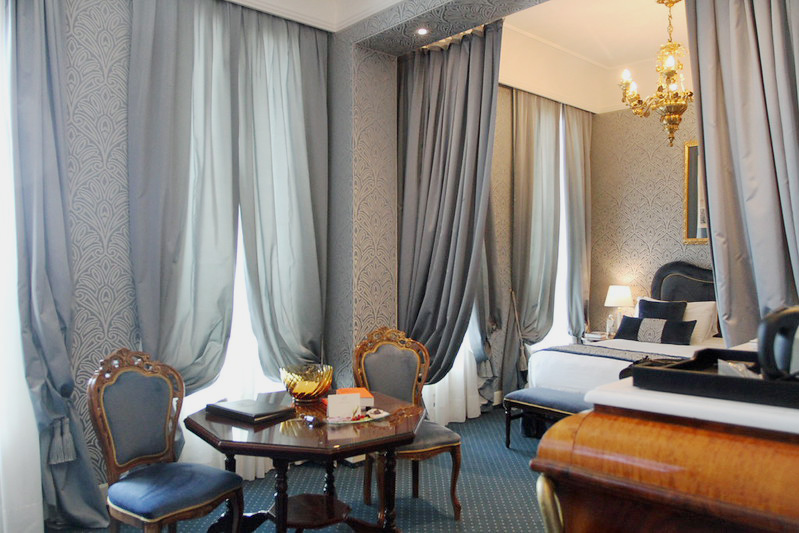
Step out of Venice’s hustle into the luxury suites at The Londra Palace. Photo: Jacquie Kubin
To the west is San Marco, home to Venice’s most cherished tourist areas includding the spectacle of St. Mark’s Square and the basilica’s glittering mosaics.
To the east, a calmer Venice, Castello, leads toward the historic Venetian Arsenal, once the powerful shipbuilding center of the Venetian Republic. A walk through Castello reveals a side of Venice many visitors never see — the Venice where people still live.
It is one of the few places near San Marco where the pace slows enough to truly enjoy the lagoon, and visitors should include at least an afternoon exploring the tree-lined streets, shops, and the Naval Yard that includes the Naval History Museum. Featuring the Venetian Navy’s long history, including many recovered vessels, private visits are available through the website.
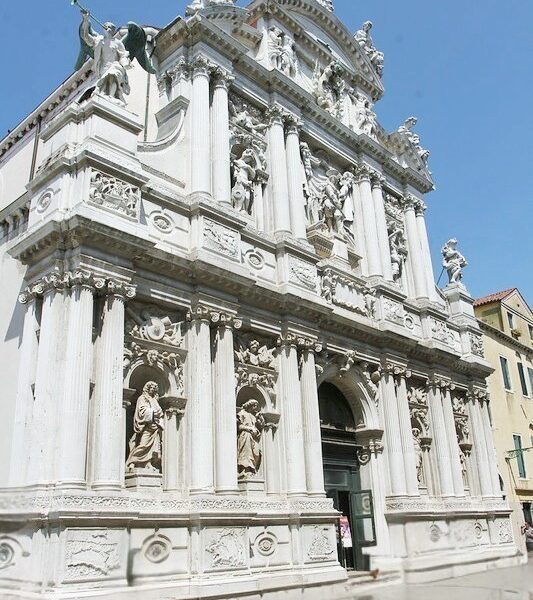
San Zaccario Church – Photo by Jacquie Kubin
The Venetian Arsenal or the Arsenale di Venezia was the state-owned shipyard and armory behind Venice’s 12th-century maritime power, securing dominance in the Mediterranean. Save time to tour the Naval History Museum. Featuring the Venetian Navy’s long history, including many recovered vessels, private visits are available through the website, including a very impressive, heavily gilded 18-oar Royal Vessel (Barchia Reale).
Just a few minutes east of the Londra Palace along the Riva degli Schiavoni sits one of Venice’s quiet historical treasures — San Zaccaria.
While the crowds surge through nearby St. Mark’s Square, the square surrounding San Zaccaria feels almost hidden. The site dates back to the 9th century and was originally built to house relics of Saint Zechariah, the father of John the Baptist. Over time, the church became an important spiritual center for the Venetian Republic, and several Venetian doges were buried here.
The structure visitors see today was largely completed in the 15th century, blending Gothic and early Renaissance architecture. Inside hangs one of Venice’s great artistic treasures, the San Zaccaria Altarpiece by Giovanni Bellini, a masterpiece of Venetian Renaissance painting known for its luminous light and serenity.
One of the church’s most unusual features lies beneath the altar: a crypt that slowly fills with lagoon water, a haunting reminder that Venice itself lives at the mercy of the sea.
Despite its importance, many visitors walk past San Zaccaria without ever stepping inside — one of the small discoveries that rewards travelers willing to wander beyond the most crowded corners of the city.
Across the city near the bustling Rialto market stands another church tied to Venice’s legendary origins: San Giacomo di Rialto.
According to tradition, the church was consecrated on March 25, 421 — the mythical founding date of Venice itself. While the current structure reflects later medieval rebuilding after fires, its location marks the earliest commercial heart of the city.
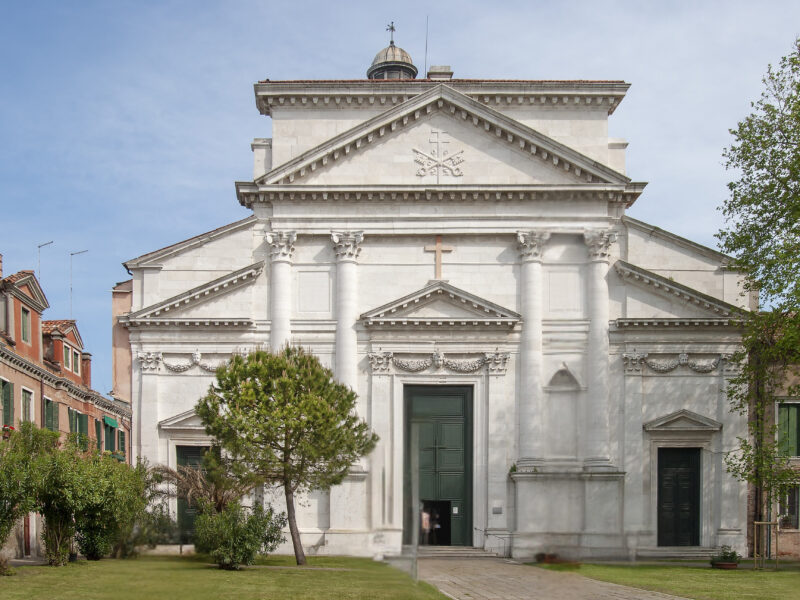
San Pietro di Castello – By Jacquie Kubin
The small church is recognizable by its five-arched Gothic portico and the 15th-century clock above its entrance. For centuries, merchants gathered beneath the portico while the surrounding square functioned as Venice’s financial center.
Today, surrounded by the vibrant Rialto market and steps from the Rialto Bridge, San Giacomo remains both an active church and a quiet reminder of the humble beginnings of a city that once ruled the seas.
Continue east beyond the Venetian Arsenal, and Venice changes again. The crowds disappear, and the city becomes residential, with quiet squares and neighborhood cafés. At the edge of the lagoon sits San Pietro di Castello, once the cathedral of Venice before St. Mark’s assumed that role in the 19th century.
The Basilica di San Pietro di Castello, commonly called San Pietro di Castello, is a Roman Catholic minor basilica of the Patriarch of Venice located in the Castello sestiere of the Italian city of Venice. The church is surrounded by buildings that served as a cloister for the church’s nuns and as an armory during times of war.
While touring Castello, find local shops, taverns and dining spots that are far away from the more touristy offerings found in San Marco on Via Garibaldi.The real luxury: Venetian hospitality
What ultimately defines a stay at the Londra Palace is not just the views or the rooms — it is the people.
Venetian hospitality feels genuine and effortless. Staff greets guests with a warmth that feels less like a hotel interaction and more like being welcomed into a long-established home.
Morning coffee overlooking the lagoon. Evening walks along the waterfront as the city quiets.
Those are the moments travelers remember most.
In a city famous for spectacle, the Londra Palace delivers something rarer: a sense of belonging in Venice.