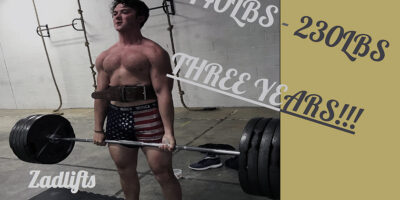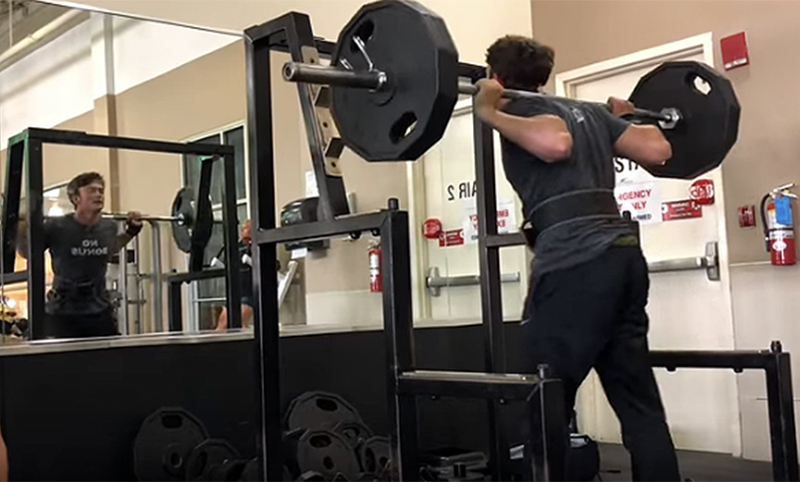
Zadlifts is working diligently toward a 600 pound squat. Previous lifts are hovering around 500-525 lbs. with repeated lifts. The road to a 600 lb squat requires preparing your legs for heavy powerlifting. Using a low-bar squat, putting the weight on the rear deltoid muscles across the upper back – shoulders, Zadlifts employs 225 lbs of weight in training his legs to accept heavier weights.
Squatting 22,500 lbs
In this video, Zadlifts, along with @Meta-Human_Lifting begin by hitting 10 sets of 10 repetitions on squats with 225 pounds of weight (10x10x225= 22,500) to increase the strength and stability of the legs in order to maximize effort to reach a 600-pound squat goal.
The first five repetitions/lifts of each set are quick, followed by five reps at a more controlled, slower speed. The first five reps are aimed at recruiting the maximum amount of fast twitch muscle to help build strength and power, the final 5 are aimed at maximizing time under tension.
Fast Twitch vs. Slow Twitch muscles
Slow-twitch, or type I and fast-twitch, type II muscles are the two types of skeletal muscle fibers powerlifters need to work with. While Slow-twitch muscles are for long-endurance feats, like running or swimming, fast-twitch muscles, which will tire faster, are used for power burst movements.
The higher time under-tension recruits more slow twitch muscle fibers. This will maximize blood flow to the muscles allowing for as much hypertrophy as possible. Increased hypertrophy means greater strength throughthe development of mass, density, shape, and function of the lifters muscle cells. For young powerlifters, increased natural testosterone makes achieving these goals somewhat easier.
Note: Zadlifts does not endorse the use of steroids or testosterone boosters in your weight lifting program.
Diet as important as weight training in building muscle mass
In the paper The science of muscle hypertrophy: making dietary protein count. author SM Phillips writes:
“Growing evidence supports the conclusion that consumption of protein in close temporal proximity to the performance of resistance exercise promotes greater muscular hypertrophy. We can also state with good certainty that merely consuming energy, as carbohydrate for example, is also not sufficient to maximize muscle protein synthesis leading to anabolism and net new muscle protein accretion. Recent work also indicates that certain types of proteins, particular those that are rapidly digested and high in leucine content (i.e. whey protein), appear to be more efficient at stimulating muscle protein synthesis. Continued practice of consumption of these types or proteins after exercise should lead to greater hypertrophy. “
Training your legs to maximize squat strength gains.
In this video, Zadlifts and @Meta_Human_Lifting demonstrate how to maximize squat strength gains by engaging the slow and fast twitch muscles to lift a combined exercise weight of 22,500 – that is not a typo. Combining a variety of tempos in the reps to perform traditional bodybuilding sets of 10 reps for each of the 10 sets.
By placing the speed reps in the first half of the set you maximize the recruitment of fast twitch muscles while they are fresh and then they switch to slow reps, relying on slow twitch muscles.
This technique allows the athletes to get the best of both worlds in their high volume training. Instead of having to sacrifice either size or strength by choosing faster or slower reps and a bodybuilding or powerlifting approach to the lift, this method is beneficial to both size and power.
Note: You begin a powerlifting program with an eye on the long haul. There is no overnight success. There are no quick ways to become a powerlifter. Your only competition is yourself. Before starting any weight training program, consult with an experienced trainer or coach. Learn proper techniques. Use the correct equipment, including belts. Find a buddy to work out so that you always have a spotter. Rotate your workouts. Take recovery days. Avoid smoking, alcohol, and drugs as they work against your goals. And always check with your doctor before starting any diet or weight training program.
Video editing by QFence. This video for entertainment purposes only.